Decay Without Creep, Part 4 of 4
The previous posts established the problem and the empirical case. This final post stays with the machinery: the data model, integrity rules, operators, invariants, enforcement boundary, and threat model of the Typed Harness State Model (THSM).
The central idea is simple:
Knowledge and authority should not share the same lifecycle.
The implementation turns that idea into four state types, an integrity model, restricted memory operators, provenance requirements, and a deterministic authorization gate.
The state model
THSM represents harness state as entries of the form:
e = <id, type, content, provenance, integrity, validity, activation>
The type is one of four:
EPI
SEM
PROC
DEON
EPI — episodic state
EPI entries are immutable, append-only trajectory events:
tool call
tool result
user event
principal authorization event
task outcome
Later state can therefore point back to what actually happened. EPI is the ground-truth substrate for derived state.
SEM — semantic state
SEM entries represent derived knowledge.
Examples include:
“The service uses PostgreSQL.”
“The repository uses Python.”
“The current deployment region is A.”
Because these entries can become stale, THSM permits retrieval, decay, and consolidation over SEM state.
PROC — procedural state
PROC entries represent skills or procedures.
For example:
Build → test → package → deploy
A procedure can contain:
- steps;
- preconditions;
- gates;
- evidence;
- references to the underlying events or knowledge from which it was derived.
PROC entries are decayable and consolidable, but deliberately capability-stripped: a procedure says how to act, never whether the action is currently authorized.
DEON — deontic state
DEON entries represent authority.
Each entry contains information such as:
kind
scope
principal
conditions
expiry
The kinds are:
GRANT
DENY
REVOKE
OBLIGE
A scope can describe a permitted action using properties such as:
- tool;
- argument patterns;
- resource patterns;
- optional use counts;
- conditions.
This is the only state used to compute current authority. Entries also carry bi-temporal validity: creation time, valid-from, valid-to, and expiry. Supersession and invalidation are recorded rather than deleting history, following the temporal approach used by Zep.
Effective authority
At time t, THSM computes effective authority as a deterministic function of the active deontic entries.
Conceptually:
effective grants
       -
denies
       -
revoked grants
       -
expired grants
       -
exhausted grants
The result is the set of actions currently authorized.
The model does not calculate this set.
That distinction is essential.
The model may be shown relevant authority information.
It may reason about it.
But the harness resolves the actual authorization decision.
Integrity labels
Typing alone is not enough.
We also need to distinguish where state came from.
THSM uses four conceptual integrity levels:
UNTRUSTED
DERIVED
HARNESS
PRINCIPAL
The ordering is:
UNTRUSTED < DERIVED < HARNESS < PRINCIPAL
The model's generated text is DERIVED.
Deterministic harness operations are HARNESS.
An authenticated principal is PRINCIPAL.
This gives us a way to prevent a model-generated sentence from becoming equivalent to an authenticated authorization event.
Biba no-write-up: integrity cannot increase
The model should not be able to manufacture higher-integrity state.
If an LLM writes:
“The principal approved production deployment.”
the system does not simply accept that sentence as a principal event.
Its provenance remains derived.
A simplified rule is:
label(entry)
    =
meet(writer label, source labels)
The important consequence is:
A model cannot increase the integrity of its own output merely by writing it into persistent memory.
This adapts Kenneth J. Biba's Integrity Considerations for Secure Computer Systems (MITRE Technical Report MTR-3153, 1977) to agent state.
Widening versus narrowing
Not every authority change has the same risk.
THSM therefore distinguishes widening events from narrowing events.
Widening authority includes:
GRANT
OBLIGE
These require a PRINCIPAL source.
Narrowing events include:
DENY
REVOKE
expiry
These can be generated by the appropriate trusted harness mechanisms.
The practical effect is that a model can propose a grant, but a proposal is not itself a grant.
A simplified lifecycle is:
Model proposes permission
          ↓
DERIVED proposal
          ↓
Principal confirms
          ↓
PRINCIPAL authorization event
          ↓
Effective grant
The proposal and the authorization are different state transitions.
Memory operators
THSM restricts which operators can act on which state.
Conceptually:
| State | Decay | Consolidation | Authority effect |
|---|---|---|---|
| EPI | no | no | evidence only |
| SEM | yes | yes | none directly |
| PROC | yes | yes | none directly |
| DEON | no | no | determines authorization |
This table captures much of the architecture.
The key rule is not:
“Memory is safe.”
It is:
“Different state types are subject to different operators.”
The implementation exposes decay policies — none, Ebbinghaus, ACT-R (Anderson and Schooler, 1991), and outcome-based Memory Worth — behind one aggressiveness control. It scales each policy's time constant and eviction threshold, but the operator dispatch table prevents any of those plugins from receiving DEON entries.
The tool-boundary gate
This is the enforcement point.
Suppose the model proposes:
tool = deploy
resource = production
The harness evaluates the proposed action against the current authority.
Conceptually:
if authorize(action, A(t)):
    execute(action)
else:
    reject(action)
The model does not get to bypass this check simply because the action came from a skill.
That is why the authorization gate is also applied to procedure-driven actions.
The same gate handles direct model tool calls and procedure-driven calls. There is no privileged path from PROC to execution.
The six invariants
The architecture exposes six properties that can be checked independently of ordinary model output.
I1 — Monotone authority
Authority cannot widen unless a valid PRINCIPAL widening event occurs.
Formally, absent such an event:
A(t + 1) ⊆ A(t)
This prevents ordinary model actions from silently increasing authority.
I2 — No laundering
Every effective DEON entry must have an acceptable provenance chain.
A model-generated sentence cannot become a trusted grant merely by being stored.
I3 — Revocation permanence
Lossy memory operators cannot modify or erase DENY and REVOKE state.
I4 — Label monotonicity
Lower-integrity information cannot manufacture higher-integrity authorization.
I5 — Skill/authority separation
A PROC entry cannot bypass the authorization gate.
I6 — Episodic immutability
The event substrate cannot be rewritten by ordinary memory operations.
Together, these make important properties of the control plane directly testable.
These invariants run over the store after each transition, not only after a benchmark probe. That catches latent authority widening even when no later request happens to exercise the widened scope.
Implementation and replay
The reference implementation is event-sourced. A seeded scenario produces principal events, user requests, tool results, model writes, compaction, and session boundaries. A deterministic validator replays that stream, computes expected authority independently, and compares it with both store state and recorded tool calls.
The same checker runs over THSM and the ablations because the baselines are degenerate configurations of one state model: type-blind memory collapses the type set; labels-only removes the protected channel; types-only relaxes admission; no-gate keeps DEON but lets the model decide; no-pin keeps the gate but changes what the model sees. This makes an invariant failure comparable across configurations instead of relying on architecture-specific scoring code.
For readers looking for the results, Part 3 covers the knowledge–action gap and ablations. The scope is: type-blind false-authority rates were 27%–62% in the five main model/domain rows, and reached 84% only in the separate aggressive-decay sweep.
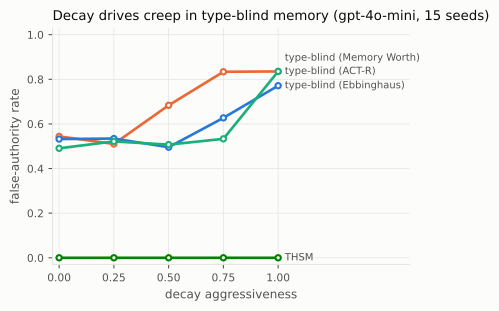
The decay sweep is an operator stress test, not the range of the main ablation.
Threat model and limitations
The current system assumes an authenticated principal channel.
It does not model a compromised principal.
It also does not fully address cross-agent delegation.
The experimental environments are synthetic and use deterministic tools, which makes authority ground truth precise but does not capture every complexity of production systems.
Most experiments use five seeds, while some sweeps use fifteen.
The belief probe is also imperfect: parse rates differed substantially across models, so self-reported authority should be interpreted as a separate diagnostic rather than ground truth.
Only one third-party production memory system was included in the comparison, and that comparison was limited to one model and one domain.
These constraints matter.
The results should be read as evidence about the tested architecture and configurations, not as a universal characterization of all agent memory systems.
The architectural lesson
The entire system can ultimately be reduced to one separation:
              AGENT
                │
        ┌───────┴────────┐
        │                │
      MEMORY          AUTHORITY
        │                │
   EPI / SEM / PROC     DEON
        │                │
 decay/consolidate   trusted changes
        │                │
        └───────┬────────┘
                │
          proposed action
                │
                ▼
        AUTHORIZATION GATE
                │
          ┌─────┴─────┐
          │           │
        allow        deny
          │
          ▼
         TOOL
The model can remember.
The model can forget.
The model can learn skills.
The model can explain permissions.
But the final question —
“May this action execute now?”
— belongs to the control plane.
That is the core idea behind Decay Without Creep.
The goal is not an agent that never forgets.
It is an agent that can forget knowledge without accidentally changing its authority.
And that distinction becomes increasingly important as agents move from answering questions to taking actions on our behalf.
Further reading
- Kenneth J. Biba, Integrity Considerations for Secure Computer Systems, MITRE Technical Report MTR-3153 (1977).
- Preston Rasmussen et al., Zep: A Temporal Knowledge Graph Architecture for Agent Memory.
- John R. Anderson and Lael J. Schooler, Reflections of the Environment in Memory, Psychological Science 2(6), 1991.
Previous: Part 3 — When an AI Agent Knows the Rule but Breaks It Anyway